
What a student writes
“I babysit my little brothers and sisters.”
What it actually is
Primary caregiver for three siblings during overnight shifts, managing meals, homework, and bedtime routines.
Common App: Family ResponsibilitiesProject Bridge helps students turn lived experience into reusable scholarship and college application material, before deadline pressure peaks.
You may already have the experiences, responsibilities, and skills that scholarships and colleges care about. They are just scattered, not written down yet. Project Bridge helps you see what they actually show, then turn them into material you can use for scholarships, essays, recommendations, and college applications.
“I babysit my little brothers and sisters.”
Primary caregiver for three siblings during overnight shifts, managing meals, homework, and bedtime routines.
Common App: Family Responsibilities“I help out at my family’s restaurant on weekends.”
Weekend operations support in a family business: inventory, cash handling, and customer service in two languages.
Common App: Paid Work“I translate stuff for my parents.”
Household translator managing medical, financial, and school communication for a multilingual family.
Leadership and responsibility evidenceThe Common App already counts caregiving, family work, and translation as legitimate application material. Most students do not know that. That is not a merit gap. It is a translation gap, and closing it is the work.

One clear signal for how ready your application material is right now.

See which parts are strong and which parts still need attention.

Know which experiences are ready to reuse and which ones need more detail.
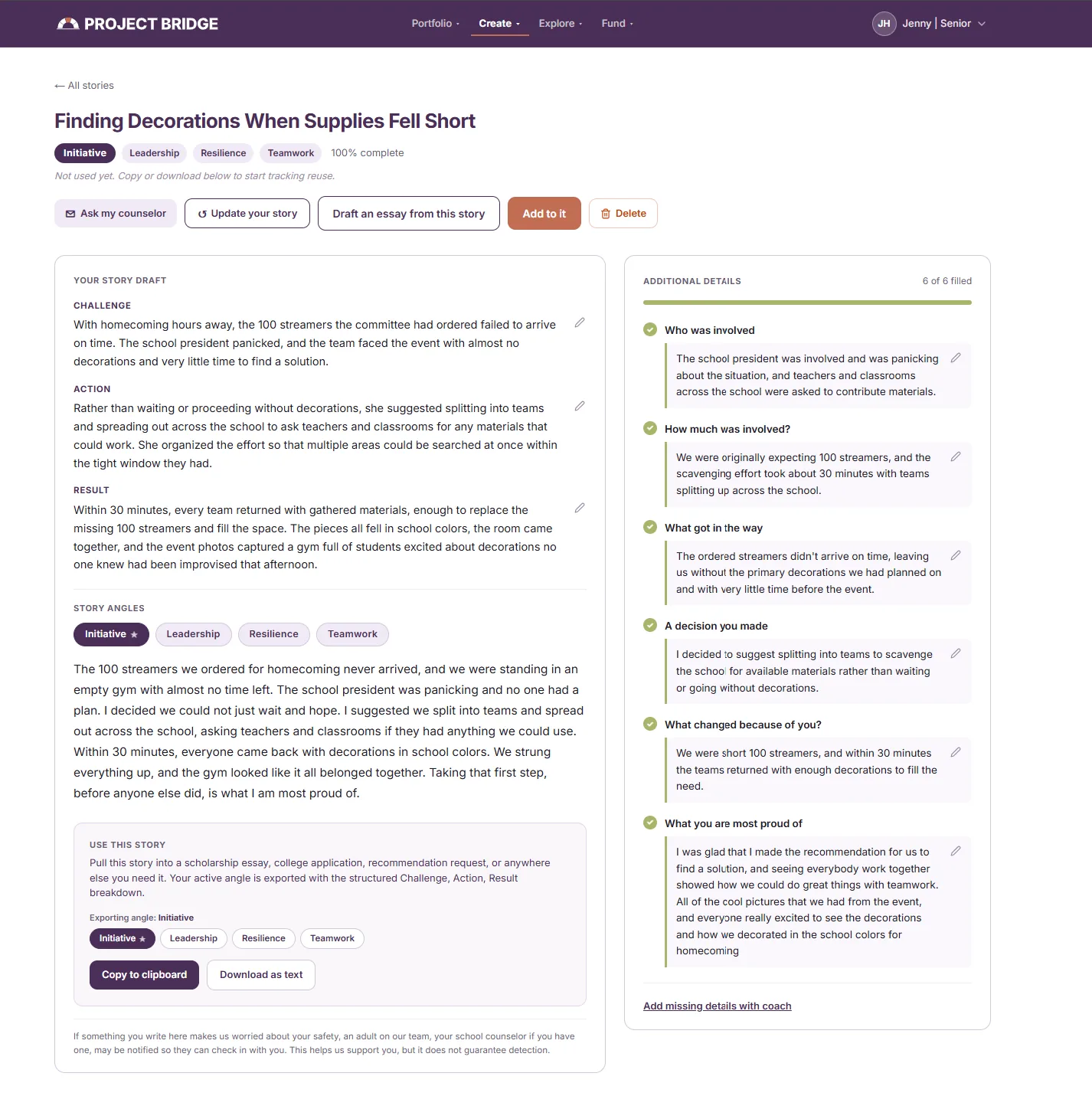
Answer a focused question about something you actually experienced.
Clarify what happened, what you decided, and what changed.
Save the Challenge, Action, Result structure for reuse later.
Start from the essay front door: build from your stories, import a draft to review, or start with the coach. Once you are writing, highlight any part of your essay to check just that section instead of the whole thing.
Project Bridge gives you feedback, examples, and templates. It does not write your essay for you. We show you how to make your own writing stronger, and that skill is yours to keep.

Browse matched scholarships and open a per scholarship breakdown of what you have met and what is still missing.
Work through your FAFSA preparation checklist and track the Cal Grant and CADAA deadlines that matter for you.

Track schools you care about and browse a curated set by type, each with real admissions and cost data.
Real questions from students figuring out what counts and where to start.
Yes, paid work is recognized application activity.
Yes, family responsibilities and caregiving are recognized application activity.
Start with the Challenge, Action, Result shape. Most strong stories come from ordinary moments told specifically.
Yes. Project Bridge helps you lead with your story and your strengths, not only your grades.
Project Bridge does not write your essay. It teaches you what good looks like so the writing stays yours.
Start with one story. Project Bridge guides the rest.
Individual access is opening soon for students 16 and up. Join the waitlist and we will email you the moment it opens.